Popularized by Dan Brown's Angels & Demons, antimatter bombs have fueled science fiction for decades. Portrayed as humanity's most devastating weapons, they tap into the intrigue surrounding antimatter. But are they truly feasible?
Rolf Landshoff, a physicist at CERN, quickly dispels the hype. "If you add up all the antimatter we've produced in over 30 years of research at CERN, you'd have just 10 billionths of a gram. Even exploding at your fingertip, it would be no more dangerous than striking a match," he explains. For context, PET scans expose patients to millions of positrons from radioactive tracers in their bloodstream—with no harm.
For comparison, 450 grams of antimatter equals about 19 megatons of TNT, far surpassing conventional explosives. Yet, production challenges make it impractical. Landshoff notes, "A single gram could cost a million billion dollars." Frank Close, particle physicist at the University of Oxford, adds, "It would take 10 billion years to produce enough for the bomb in Dan Brown's Angels & Demons." That's beyond any leader's investment horizon.
A remote chance exists for hybrid systems using antimatter-catalyzed nuclear pulse propulsion. Tiny antimatter bursts trigger micro nuclear explosions—ideal for NASA's spacecraft propulsion concepts.
Theoretically, this could yield compact, low-fallout weapons with nuclear-level impact but minimal contamination. Still, costs remain prohibitive without natural antimatter sources. Quantities like 10-13 grams (or 1011 anti-hydrogen atoms) are more achievable than pure antimatter bombs, but safe storage eludes us.
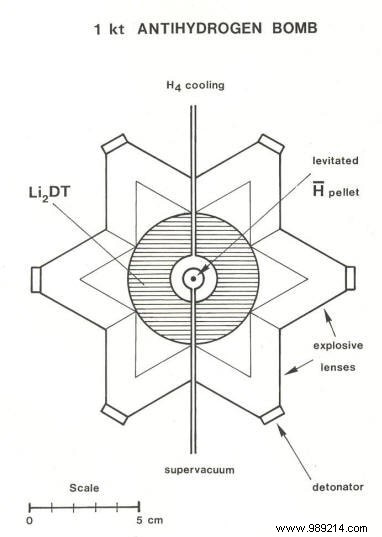
The U.S. Air Force has funded antimatter research since 1983, per a RAND Corporation study. Explored applications include propulsion, energy generators, directed-energy weapons, and classified military uses like triggered bombs.
Antimatter's greatest potential lies in propulsion. NASA eyes it as the ultimate rocket fuel, potentially reaching Mars in just six weeks, as Penn State researchers envision.
Antimatter-initiated microfusion (AIM) leverages tiny amounts to ignite nuclear reactions, releasing energy 10 billion times greater than hydrogen-oxygen combustion per unit mass. A microgram could power long missions, but storage technology remains the key barrier.
